
An agreement that enables them to keep the house was reached this week
during a court-ordered settlement conference.
A gag order prevents those involved from sharing details. But the
bottom line is that the Clauers once again own their home in the Heritage Lakes
subdivision.
“The family is very pleased that this matter has been resolved,” said
their attorney."
Showing posts with label US Army. Show all posts
Showing posts with label US Army. Show all posts
Wednesday, July 28, 2010
Frisco Soldier Gets Home Back
It's being reported today in the Dallas Morning News that Captain Michael Clauer is getting his home back. As is the usual nature of litigation and negotiation, no terms are disclosed. Courtesy the DMN:

Friday, May 28, 2010
Closing Out May
The arrival of Memorial Day Weekend signals the end of May and the real start of summer. Kids will get out of school at the end of next week, and my wife, herself a teacher, will have to find something productive to do with your time other than doing lesson plans and dealing with other people's children.
I'll keep the Memorial Day comments short: Memorial Day was enacted by Congress originally as 'Decoration Day' to commemorate U.S. service members who died during the Civil War. Over the years it was expanded to include later wars and conflicts. Traditionally, the remembrance is tied to 30 May, but in later decades the observance was shifted to facilitate a Federal holiday and expanded weekend. Traditionalist insist on adhering to the thirtieth of May, while I'm certain there's a good chunk of us who appreciate a couple of days off at the end of the month.
Enough eulogizing.
May was rough on the Deep Strike Battalion. We lost a Soldier and made our way through a field exercise, albeit the latter more by sheer force and willpower than style and finesse. I, for one, am glad to put May in the rear view mirror.
In the three weeks I separated myself from my writing, a new idea struck. Within a couple of weeks, a plot outline appeared. As of yesterday, the first couple chapters stretched across my Macbook.
Already knee-deep in two other projects, a WIP and a rewrite, the last thing I needed was a third novel. But there it is. I've decided to keep fleshing it out as long as the ideas keep coming. Like my second project, it's markedly different than its predecessor. This particular inspiration is another UFYA, but with a third-person narrative and multiple POVs.
I'm comfortable sticking with the first-person narrative, but at this point in my development, I refuse to shoehorn myself into any particular style or format.

By: Twitter Buttons
Last: I discovered Twitter (much to the chagrin of several of my fellow OWG members). After battling a dizzying array or malfunctioning widgets and a stubborn government firewall, what you see in the column on the right is my new Twitter feed, appropriately named 'Bulletwisdom.'
Unfortunately, all variations of my name were already taken.
Aspiring authors and fellow bloggers take note: Within a couple of hours, the traffic to this site jumped. This lends to the lessons that if you plan to utilize an online marketing strategy, including blogs and social networking, you need a holistic approach that includes all of the above. Links are important. You might have an great blog and a thousand followers, but if the two somehow don't meet in the middle, it counts as a missed opportunity.
That's it. Nothing profound. Remember, it's Memorial Day. While you're with your family and friends, take a moment to commemorate the service members who fell while defending our country.
I'll keep the Memorial Day comments short: Memorial Day was enacted by Congress originally as 'Decoration Day' to commemorate U.S. service members who died during the Civil War. Over the years it was expanded to include later wars and conflicts. Traditionally, the remembrance is tied to 30 May, but in later decades the observance was shifted to facilitate a Federal holiday and expanded weekend. Traditionalist insist on adhering to the thirtieth of May, while I'm certain there's a good chunk of us who appreciate a couple of days off at the end of the month.
Enough eulogizing.
May was rough on the Deep Strike Battalion. We lost a Soldier and made our way through a field exercise, albeit the latter more by sheer force and willpower than style and finesse. I, for one, am glad to put May in the rear view mirror.
In the three weeks I separated myself from my writing, a new idea struck. Within a couple of weeks, a plot outline appeared. As of yesterday, the first couple chapters stretched across my Macbook.
Already knee-deep in two other projects, a WIP and a rewrite, the last thing I needed was a third novel. But there it is. I've decided to keep fleshing it out as long as the ideas keep coming. Like my second project, it's markedly different than its predecessor. This particular inspiration is another UFYA, but with a third-person narrative and multiple POVs.
I'm comfortable sticking with the first-person narrative, but at this point in my development, I refuse to shoehorn myself into any particular style or format.
By: Twitter Buttons
Last: I discovered Twitter (much to the chagrin of several of my fellow OWG members). After battling a dizzying array or malfunctioning widgets and a stubborn government firewall, what you see in the column on the right is my new Twitter feed, appropriately named 'Bulletwisdom.'
Unfortunately, all variations of my name were already taken.
Aspiring authors and fellow bloggers take note: Within a couple of hours, the traffic to this site jumped. This lends to the lessons that if you plan to utilize an online marketing strategy, including blogs and social networking, you need a holistic approach that includes all of the above. Links are important. You might have an great blog and a thousand followers, but if the two somehow don't meet in the middle, it counts as a missed opportunity.
That's it. Nothing profound. Remember, it's Memorial Day. While you're with your family and friends, take a moment to commemorate the service members who fell while defending our country.
Saturday, May 22, 2010
A Memorial
A couple weeks back, our Battalion lost a Soldier. Private First Class Barry Smith left this world far too soon. Only a month in the unit, Barry impacted everyone around him. He was talented, ambitious, creative, and gregarious, possessing a monster work ethic that would have seen him rise to the top of the profession. God decided he was too good for us, and brought him home.
This week my battalion did some platoon-level training and live fire. It was a tiring week. We ran each of our 6 platoons through a thirty-six hours training 'lane' consisting of events that would test their ability to perform basic, required tasks.
No room for error. Because of the tragedy, we compressed what my Brigade Commander called a 'tight timeline' to an insane point where if any of the platoons were hung up, it would adversely affect the training of the entire battalion.
Transparent to each of the platoons, was the tireless work of my Officers and NCOs. They worked tirelessly to make a great training event. We were fielding new equipment, training on new systems, introducing new personnel to the staff, and executing an aggressive.
But we made it, and made the news in the process. When we got back to the rear, we were smoked, completely drained by humidity, frustrating moments, and lack of sleep.
Then I got an email from Jodi Meadows. She posting a critique of my query at her site, (W)ords and (W)ardances. Last fall, I had limited success submitting my YA, EMANARE, with what I considered a train wreck of a query letter. What can I say? I was young. She's the first to look at the redo, so I'm hoping with her assistance and a better overall product, I can move forward.
This is my first weekend home in three weeks. Overall, May has been the toughest month on the job. Can't wait for June.
UPDATE - Jodi's critique of my query letter is up her site here. She provided some extremely helpful observations. Thanks Jodi!
This week my battalion did some platoon-level training and live fire. It was a tiring week. We ran each of our 6 platoons through a thirty-six hours training 'lane' consisting of events that would test their ability to perform basic, required tasks.
No room for error. Because of the tragedy, we compressed what my Brigade Commander called a 'tight timeline' to an insane point where if any of the platoons were hung up, it would adversely affect the training of the entire battalion.
Transparent to each of the platoons, was the tireless work of my Officers and NCOs. They worked tirelessly to make a great training event. We were fielding new equipment, training on new systems, introducing new personnel to the staff, and executing an aggressive.
But we made it, and made the news in the process. When we got back to the rear, we were smoked, completely drained by humidity, frustrating moments, and lack of sleep.
Then I got an email from Jodi Meadows. She posting a critique of my query at her site, (W)ords and (W)ardances. Last fall, I had limited success submitting my YA, EMANARE, with what I considered a train wreck of a query letter. What can I say? I was young. She's the first to look at the redo, so I'm hoping with her assistance and a better overall product, I can move forward.
This is my first weekend home in three weeks. Overall, May has been the toughest month on the job. Can't wait for June.
UPDATE - Jodi's critique of my query letter is up her site here. She provided some extremely helpful observations. Thanks Jodi!
Monday, May 3, 2010
No Thin Skins
I'm still a relative noob when it comes to writing. Not a week goes by that I don't learn something useful from my friends in the OWG at Kelley Armstrong's Otherworld Forums. Today I got exactly what I needed: a good swift kick in the rear.
In a moment of weakness, I let some criticism get under my skin. Now I get criticism of all sorts from my OWG friends, some harsher than others. Their's never phases me, after all, it's not personal, they give of their free time to assist my development, and I'm appreciative of their efforts. It's kind of like getting whacked on the ass in a college fraternity and saying, 'Thank you sir, may I have another?'
Initially, I wasn't very appreciative of the Publisher's Weekly review I received as a prize for making through to the ABNA Quarterfinals. The editor used phrases like gauche, limited promise, apropos of nothing, and watered down. I was rather enraged. I fumed, stormed about the office, complained to my OWG mates. A good hour of the productivity was lost to my private little tantrum.
Then there was a cup of coffee, a meeting, some work that needed to get done. For a moment, I was lost in solving tax-payer funded issues. I did what a Field Grade officer gets paid to do: solve macro problems. When I sat back down in front of my laptop, my perspective had changed.
Years ago, as a Lieutenant, training at the National Training Center in Fort Irwin, California, I would attend After Action Reviews (AARs) following each engagement. The memorable rule of the AAR: No Thin Skins. Sometimes the truth hurts, especially when it comes from an anonymous source.
The rule still applies. It's not personal; you're only going to learn if you're will to take your pitches high and inside. As I've grown as a writer, my early inadequacies became glaringly obvious. I've known about the issues with my manuscript. The individuals who read the manuscript came to similar, albeit somewhat less despotic conclusions. The book I entered in the ABNA was completed in July of last year, months before my adventures in a writing group even began.
So I'm thankful for my anonymous professional reviewer. They confirmed the suspected shortcomings and helped me regain some of the perspective I'd lost while cramming in my myopic little writer's cave.
Given the impossibly small percentage of writer's that end up with their work on the shelf of a local bookstore, I anticipate many more of these insightful critiques. I'll survive.
In a moment of weakness, I let some criticism get under my skin. Now I get criticism of all sorts from my OWG friends, some harsher than others. Their's never phases me, after all, it's not personal, they give of their free time to assist my development, and I'm appreciative of their efforts. It's kind of like getting whacked on the ass in a college fraternity and saying, 'Thank you sir, may I have another?'
Initially, I wasn't very appreciative of the Publisher's Weekly review I received as a prize for making through to the ABNA Quarterfinals. The editor used phrases like gauche, limited promise, apropos of nothing, and watered down. I was rather enraged. I fumed, stormed about the office, complained to my OWG mates. A good hour of the productivity was lost to my private little tantrum.
Then there was a cup of coffee, a meeting, some work that needed to get done. For a moment, I was lost in solving tax-payer funded issues. I did what a Field Grade officer gets paid to do: solve macro problems. When I sat back down in front of my laptop, my perspective had changed.
Years ago, as a Lieutenant, training at the National Training Center in Fort Irwin, California, I would attend After Action Reviews (AARs) following each engagement. The memorable rule of the AAR: No Thin Skins. Sometimes the truth hurts, especially when it comes from an anonymous source.
The rule still applies. It's not personal; you're only going to learn if you're will to take your pitches high and inside. As I've grown as a writer, my early inadequacies became glaringly obvious. I've known about the issues with my manuscript. The individuals who read the manuscript came to similar, albeit somewhat less despotic conclusions. The book I entered in the ABNA was completed in July of last year, months before my adventures in a writing group even began.
So I'm thankful for my anonymous professional reviewer. They confirmed the suspected shortcomings and helped me regain some of the perspective I'd lost while cramming in my myopic little writer's cave.
Given the impossibly small percentage of writer's that end up with their work on the shelf of a local bookstore, I anticipate many more of these insightful critiques. I'll survive.
Saturday, February 27, 2010
New DoD Policy Embraces Social Media
Last week was pretty huge for me for two reasons. First, author Jim Butcher personally provided some tremendously helpful advice, and second, my manuscript made it to the second round of the Amazon Breakthrough Novel Award. I was working on this week's post, a look at the Fort Hood Esquire article, but late in the week, the Department of Defense issued Directive-Type Memorandum (DTM) 09-026 - The DoD's policy for Responsible and Effective Use of Internet-based Capabilities.
For the last few years, the Army and other services faced a conundrum: How do you maintain operational security during a period of protracted conflict while dealing with the rapidly increasing popularity of social media. The policies that evolved from the problem were as inconsistent as they were perceived by the field to be unfair towards a young generation of service members who grew up with the expectation of free speech through social media.
It was difficult to watch senior leaders tweet and blog while Soldiers in the field were occasionally disciplined for doing nothing more than voicing their own opinion. Of course, this is the military, none of us are under the illusions that we service members have the same free speech rights as the rest of the civilian population. Nonetheless the perception of disparity was out there. Generals and Admirals Tweeted and Facebooked while Privates and Lieutenants were blocked from reaching the same sites.
The disparity needed to be address. The DoD recognized the disparity as well as the changing landscape of social media and its implications in the broader scheme. So, smart dudes gathered, panels conducted, and recommendations made. And after months of speculation, this last week the policy went public.
Basically, the new, unified policy allows access to social media outlets (Facebook, Twitter, YouTube, blogs) while still authorizing commanders in the field to "defend against malicious activity” and to bar access to sites with pornography, gambling or hate-crime content. Commanders can also block access to social media sites, particularly YouTube, as necessary to protect a mission or protect sufficient bandwidth, but, and this is a big but, only on a temporary basis.
It's no secret that I stopped posting to my blog because my local command in Iraq was uncomfortable with my blogging while they restricted the content of their own Soldiers. I had no problem shutting things down in the name of fairness and good order and discipline, but privately, I didn't enjoy seeing higher institutions blog away while those of us in the field watched from behind a firewall of mistrust.
Like many other Milbloggers, I don't thing this is going to have a huge impact on the great scheme of things. Soldiers that want to blog and Facebook did it anyway. They simply used friends and family members to get out their message. If anything, this new policy is more of an assist to commanders in the field, who now have clear guidance from their higher how to handle social media.
The public should see this as a reminder that there is a small percentage of the population serving you with honor and pride, and while we defend your rights of free expression, we are not granted them ourselves. I'll get back to writing about writing next week.
For the last few years, the Army and other services faced a conundrum: How do you maintain operational security during a period of protracted conflict while dealing with the rapidly increasing popularity of social media. The policies that evolved from the problem were as inconsistent as they were perceived by the field to be unfair towards a young generation of service members who grew up with the expectation of free speech through social media.
It was difficult to watch senior leaders tweet and blog while Soldiers in the field were occasionally disciplined for doing nothing more than voicing their own opinion. Of course, this is the military, none of us are under the illusions that we service members have the same free speech rights as the rest of the civilian population. Nonetheless the perception of disparity was out there. Generals and Admirals Tweeted and Facebooked while Privates and Lieutenants were blocked from reaching the same sites.
The disparity needed to be address. The DoD recognized the disparity as well as the changing landscape of social media and its implications in the broader scheme. So, smart dudes gathered, panels conducted, and recommendations made. And after months of speculation, this last week the policy went public.
Basically, the new, unified policy allows access to social media outlets (Facebook, Twitter, YouTube, blogs) while still authorizing commanders in the field to "defend against malicious activity” and to bar access to sites with pornography, gambling or hate-crime content. Commanders can also block access to social media sites, particularly YouTube, as necessary to protect a mission or protect sufficient bandwidth, but, and this is a big but, only on a temporary basis.
It's no secret that I stopped posting to my blog because my local command in Iraq was uncomfortable with my blogging while they restricted the content of their own Soldiers. I had no problem shutting things down in the name of fairness and good order and discipline, but privately, I didn't enjoy seeing higher institutions blog away while those of us in the field watched from behind a firewall of mistrust.
Like many other Milbloggers, I don't thing this is going to have a huge impact on the great scheme of things. Soldiers that want to blog and Facebook did it anyway. They simply used friends and family members to get out their message. If anything, this new policy is more of an assist to commanders in the field, who now have clear guidance from their higher how to handle social media.
The public should see this as a reminder that there is a small percentage of the population serving you with honor and pride, and while we defend your rights of free expression, we are not granted them ourselves. I'll get back to writing about writing next week.
Sunday, April 19, 2009
Sitting Around a Map
Another crowded, smoke-filled room with forty or so people gathered around another long table with a projector at the end throw up a picture of a map on a too-small screen. From my position, the whiny fan on the aged Canon digital projector obscures the voices coming from the other end of the long, rectangular room.
Today at the command center, many of the provincial players from nearby Iraqi Security Forces (ISF) gathered at our weekly meeting. Normally used to discuss the previous weeks SIGACTS, or Significant Actions, the agenda from this week was to highlight the impact of the ISF ongoing turf wars. Now, these are not turf wars where one group encroaches on the territory of another. The problem here is ISF units in our areas are hesitant to engage outside of their given Area of Responsibility.
The cloud hanging over the table is the assassination of another influential sheik the previous night. The enemy, conveniently dubbed as al Quada, uses a policy to alienate the highly successful Sons of Iraq contracted-militias from ISF and Coalition Forces. The strategy is clear; alienate the people from the Government of Iraq and Coalition Forces by attacking a linchpin of Coalition support.
Areas of Operations, or Areas of Responsibility, are pieces of land handed to us by our higher headquarters with the intent of preventing conflicting operations between friendly forces. In a perfect world, all the Areas would bump up against each other to provide maximum coverage to throughout the province. However, this is not a perfect world, and the Areas do not bump up against each other.
As each representative from the Iraqi Army, various Iraqi Police departments, and the National Police go to the map and draw their Areas, it become apparent that there are 1) a lot of overlapping areas and 2) a lot of gaps with no one claiming responsibility. Not surprisingly, the murder of the influential sheik happened in one of these gaps.
Also not surprising, is the use of these areas as enemy safe havens. Overlapping areas of responsibility appear to be in cities and on major highways. The gaps and enemy safe havens appear among rural areas and agricultural communities, well off the beaten path and difficult to access with the Coalition new, larger IED-resistant MRAP vehicles. By looking at reports of enemy activity and traffic through the province, we see that our enemy knows where the gaps are and is exploiting them to his advantage.
This is changing. All the professionals around the table now look at the map and see themselves hamstrung by poorly coordinated lines arbitrarily drawn on a map without much consideration for history or the enemy. The Coalition Force commander quoted Sun Tzu when he called this first step, "seeing ourselves."
Our next step is to take our maps and gaps and identify the enemy, his patterns, and his networks. This is called, "seeing the enemy." This includes sharing intelligence in a country where mishandling your 'source' could get someone killed. That portion will probably prove difficult given the turbulent history of distrust between the different Iraqi Security Force entities. Sharing will be a challenge.
We'll cross that bridge when we get there.
Sunday, February 22, 2009
Sons of Iraq

Last week, my team travelled to Tikrit to sit in on a transition meeting between the Iraqi Army, Coalition Forces and contractors representing almost 10,000 Sons of Iraq contractors from our province. On March 1, the process for transition supervision and responsibility for Sons of Iraq (SOI) formally begins in the Salah ah Din province. There are over 2,000 alone in my area, and over the next several months, the Prime Minister ordered all to transition to the employ of either the Ministry of Defense or Interior (Army or Police) or to a position somewhere with the Government of Iraq.
So who are these Sons of Iraq guys? Listening to some, you would believe that a good deal of these individuals where the guys we fought pre-Surge, back in 2005-2006. There is a good deal of truth to that. For young men trying to put food on the table for their family, they based their roles as insurgents almost as much on economic opportunity as they did idealism. Now they are beneficiaries of Iraq’s National Reconciliation Program. Formerly, the insurgents and terrorists were among the few available employers to young Iraqi males.
Enter the Surge and the Sons of Iraq. Part of any decent counterinsurgency, is figuring out how to convince insurgents to lay down their arms and take up jobs. The brilliance of the Sons of Iraq is that now you let them to do both. Hundreds of thousands of Sons of Iraq took their weapons and under the guidance and supervision of Coalition Forces, boldly stepped into their new roles of providing security to the people of Iraq.
Many of them, who were part of the problem, became part of the solution. Together, they provided security coverage far into areas of Iraq where Coalition Forces and the Iraqi Army did not. The fought insurgents bravely, sometimes in spite of themselves, and ultimately many sacrificed their lives in the name of the Iraqi People.
Not all SoI were part of the insurgency that swept across Iraq. Many are hard working Iraqis taking advantage of classic economic theory. We had a demand for security, many of those young men stepped in to fill it. Some came from the other side as part of reconciliation, but most were just looking for jobs.
Back to this week, many were represented in that room in Tikrit. Their sheiks were there to receive a briefing from the Iraqi Division Commander and provincial Governor on the details of the transfer. When they opened the floor to questions, there were many: Complaints of inconsistent pay; unfulfilled promises from Coalition Forces; logistical support; compensation for fallen SoI. The sheiks asked hard questions and unfortunately, there were few answers.
Cameras lined both sides of the meeting room. Interviews conducted after the meeting indicated high degrees of both hope and pessimism. There is no question that the SoI were part of the formula that greatly reduced the violence. Some were argue that they were THE critical part.
The mission now is transitioning them over the Iraqi military control. It will not be easy. Our Iraqi counterparts have difficulty dealing with their own pay and administration. Now we will gradually load thousands of additional SoI and their related issues on the shoulders of the Iraqi Army.
Our counterparts appear to be up to the challenge. In the last week, they worked late into the night to come up with a plan to focuses on integrating control of the Sons of Iraq into our brigade, while emphasizing the treatment of SoI with dignity and respect. The latter is a difficult task, not so long ago many of the IA and SoI were on opposite lines of the counterinsurgency campaign.
Now, the leadership see the SoI as an extension of their operational reach, capable of providing additional security and intelligence to the Iraqi Army. This will be our most important mission over the next several months. So far, all is well. Personally, I want to see all the SoI integrated into their new positions within the Iraqi Security Forces or government employ. Count me in the crowd that does not want to see them cross back over to the other side.
Tuesday, February 10, 2009
Mending Fences
The Army is not all Kevlar and testosterone. Over the years I have come to the realization that people, not tanks and helicopters, make the Army go. Of course, it's the same as in the civilian world. You have to work with people in order to accomplish your objectives.
Over the last week, we had two objectives. First, we had to get out into our battle space and find where we fit in the grand scheme of things. Just tackling the weekly rhythm alone was a daunting task. There were meetings scattered all over the calendar and the map.
We quickly realized was that with a small, geographically isolated team you could not get everywhere for every meeting. If we did, we would spend all our time on the road going to meetings rather than performing our primary duty: advising an Iraqi Infantry Brigade.
That process is still ongoing. We're whittling the large list of meetings down to a few. We're figuring out where we need to plug in to maximize our effects. It'll be another couple of weeks, but it should pay off for us in the long run. The important part is trying to find the right forum for connection our Iraqi and Coalition counterparts. That's the key to success and will require additional work.
Our other objective was to get out and work on relationships. Before coming here, we were told that our primary problem would be lack of support from coalition partners In other words, don't bother asking for help because none will come.
The reality we discovered was very different. Coalition units have bent over backwards to provide the support needed for us to execute our mission. The primary difference between what I'll categorize as 'then-and-now' is simply personalities. We've made it a point of emphasis to get out there and shake hands with units throughout our area of operations. Already, the payoff is huge.
It is yet another reminder that an e-mail is never as good as a phone call or a handshake. Oh, and that you get more with sugar than salt.
Over the last week, we had two objectives. First, we had to get out into our battle space and find where we fit in the grand scheme of things. Just tackling the weekly rhythm alone was a daunting task. There were meetings scattered all over the calendar and the map.
We quickly realized was that with a small, geographically isolated team you could not get everywhere for every meeting. If we did, we would spend all our time on the road going to meetings rather than performing our primary duty: advising an Iraqi Infantry Brigade.
That process is still ongoing. We're whittling the large list of meetings down to a few. We're figuring out where we need to plug in to maximize our effects. It'll be another couple of weeks, but it should pay off for us in the long run. The important part is trying to find the right forum for connection our Iraqi and Coalition counterparts. That's the key to success and will require additional work.
Our other objective was to get out and work on relationships. Before coming here, we were told that our primary problem would be lack of support from coalition partners In other words, don't bother asking for help because none will come.
The reality we discovered was very different. Coalition units have bent over backwards to provide the support needed for us to execute our mission. The primary difference between what I'll categorize as 'then-and-now' is simply personalities. We've made it a point of emphasis to get out there and shake hands with units throughout our area of operations. Already, the payoff is huge.
It is yet another reminder that an e-mail is never as good as a phone call or a handshake. Oh, and that you get more with sugar than salt.
Sunday, February 1, 2009
Election Day
Yesterday was a great day.
For the past week, out RIP/TOA focused on integrating our new team with our Iraqi counterparts and preparing for the 31 January Provincial Elections. The Iraqi and Coalition Forces managed to exceed all expectations in providing safe voting locations for the Iraqi people to come and practice their freedoms. For weeks in the region, enemy insurgent activity has been on the decline. There were two schools of thought on why.
First, pressure on the insurgents is intense. In the weeks up to the elections Iraqi and Coalition Forces continually applied pressure throughout our region. Coalition patrols and a huge amount of checkpoints run by the Iraqi Army and Sons of Iraq denied insurgents freedom of movement throughout the sector.
Second, most of our experts predicted that the downturn in violence was a tactic by insurgents to save up for large, attention getting strikes against the coalition and populace on election day. It made sense. Given the pressure placed on insurgent by Coalition and Iraqi forces, the natural assumption was that insurgent would be desperate for attention and go for the big election day hit.
What was my team's role in all this? After all, we were only on the ground for one week. This time, we were the observers. We integrated ourselves with our Iraqi counterparts. We checked and double checked their preparations. We coordinated with our Coalition counterparts throughout the region to ensure that everyone was on the same sheet of music.
When election day came, we watched, and we prayed.
Nothing happened. There were reports of a few small incidents regarding celebratory gunfire, but on whole, it was a rather quiet day. As the clock ticked, we bit our lip and held on. Everyone waited by the radio, waiting for a report from a polling station of a monstrous attack. Coalition and Iraqi Quick Reaction Forces stood by, ready to handle the worst.
The worst never came. The Iraqi people again pointed their signature ink-dipped fingers in the air, again showing a sign of victory and defiance. We still hold our breath, waiting for that big, attention-grabbing attack. Waiting for someone to break the quiet. When it comes, our Iraqi counterparts are ready, and we will be there alongside them.
Again, yesterday, was a great day.
For the past week, out RIP/TOA focused on integrating our new team with our Iraqi counterparts and preparing for the 31 January Provincial Elections. The Iraqi and Coalition Forces managed to exceed all expectations in providing safe voting locations for the Iraqi people to come and practice their freedoms. For weeks in the region, enemy insurgent activity has been on the decline. There were two schools of thought on why.
First, pressure on the insurgents is intense. In the weeks up to the elections Iraqi and Coalition Forces continually applied pressure throughout our region. Coalition patrols and a huge amount of checkpoints run by the Iraqi Army and Sons of Iraq denied insurgents freedom of movement throughout the sector.
Second, most of our experts predicted that the downturn in violence was a tactic by insurgents to save up for large, attention getting strikes against the coalition and populace on election day. It made sense. Given the pressure placed on insurgent by Coalition and Iraqi forces, the natural assumption was that insurgent would be desperate for attention and go for the big election day hit.
What was my team's role in all this? After all, we were only on the ground for one week. This time, we were the observers. We integrated ourselves with our Iraqi counterparts. We checked and double checked their preparations. We coordinated with our Coalition counterparts throughout the region to ensure that everyone was on the same sheet of music.
When election day came, we watched, and we prayed.
Nothing happened. There were reports of a few small incidents regarding celebratory gunfire, but on whole, it was a rather quiet day. As the clock ticked, we bit our lip and held on. Everyone waited by the radio, waiting for a report from a polling station of a monstrous attack. Coalition and Iraqi Quick Reaction Forces stood by, ready to handle the worst.
The worst never came. The Iraqi people again pointed their signature ink-dipped fingers in the air, again showing a sign of victory and defiance. We still hold our breath, waiting for that big, attention-grabbing attack. Waiting for someone to break the quiet. When it comes, our Iraqi counterparts are ready, and we will be there alongside them.
Again, yesterday, was a great day.
Saturday, January 24, 2009
RIP/TOA
Relief in Place/Transfer of Authority (RIP/TOA) is the process where one coalition unit takes the place of another. Over the next several days, each member of the team will spend his time following around his counterpart trying to absorb everything that was accomplished over the last year, as well as the mundane stuff such as admin, reports, etc...
We had an initial dinner with the IA (Iraqi Army) brigade executive officer. It was an informal sit down dinner where both teams had the opportunity to dine at the Iraqi officer's mess. Not all our IA counterparts were present. Mine was currently unavailable so I will have to wait until another time. Their manning is run different than ours. The either live with the unit, or with their family. Because of the danger to them and their family, the two do not mix. They will spend a few weeks living on the base, then quietly slip out to return to their family.
Once we have the systems in place, it will still take quite a bit of time to gain a complete understanding of our new surroundings. The Iraqis place a high degree of value in personal relationships. Relationships take time. Right now the old team enters a room and receives the full embrace from the IA chain of command. Currently, we merit only a handshake. We will earn that trust over time with sweat.
RIP/TOA is not the only thing going on. Lower in priority, we're working through the amenities portion of our new surroundings. Currently I'm in the MWR facility provided by the coalition unit in charge of the FOB. The mess hall they provide, from what I hear, is a huge upgrade. We are currently coordinating to get Internet access into our personal rooms, and there are many options. Unfortunately they are all barely acceptable and expensive. Oh well, you do what you have to do.
So what's coming up? Well, national elections are fast approaching. We plan on being very, very busy.
We had an initial dinner with the IA (Iraqi Army) brigade executive officer. It was an informal sit down dinner where both teams had the opportunity to dine at the Iraqi officer's mess. Not all our IA counterparts were present. Mine was currently unavailable so I will have to wait until another time. Their manning is run different than ours. The either live with the unit, or with their family. Because of the danger to them and their family, the two do not mix. They will spend a few weeks living on the base, then quietly slip out to return to their family.
Once we have the systems in place, it will still take quite a bit of time to gain a complete understanding of our new surroundings. The Iraqis place a high degree of value in personal relationships. Relationships take time. Right now the old team enters a room and receives the full embrace from the IA chain of command. Currently, we merit only a handshake. We will earn that trust over time with sweat.
RIP/TOA is not the only thing going on. Lower in priority, we're working through the amenities portion of our new surroundings. Currently I'm in the MWR facility provided by the coalition unit in charge of the FOB. The mess hall they provide, from what I hear, is a huge upgrade. We are currently coordinating to get Internet access into our personal rooms, and there are many options. Unfortunately they are all barely acceptable and expensive. Oh well, you do what you have to do.
So what's coming up? Well, national elections are fast approaching. We plan on being very, very busy.
Saturday, January 17, 2009
Training at Taji
Last week I think we were waiting on a plane ride to Baghdad. Well, the plan arrived and we began our arduous journey north. Actually it was not all that difficult. We flew by C17 from Kuwait to Baghdad International Airport. They packed us into the huge aircraft like sardines. It was truly elbow to elbow with bags stacked everywhere. It was so crowded we were not allowed to get up to use the bathroom in flight. On a positive note, the C17 is a hell of an aircraft. It was a comfortable ride and one could barely feel the landing.
Here's a hint for you future TT deployers: They'll let you have two carry-on's when you leave Kansas, a backpack such as an assault pack plus a laptop bag. They both fit in a wooden box they use a screening. However, The Air Force only lets you have one when you fly from to Baghdad. So make sure your laptop bag, if that's what you plan to use, can hold a bit more than a laptop i.e. about 24 hours of provisions (shave kit, poncho liner, etc). I would suggest a tactical looking laptop backpack and stow the assault pack. Leave Fort Riley with only one bag in hand. The fewer the bags the less the hassle down the road.
From Baghdad, they moved us by helicopter under darkness to Taji. We stacked ourselves and our gear into Chinooks, large dual rotor aircraft, and took off into the darkness. Of course, with helicopters you move with no light and a ton of air flowing through the back so it's always an experience. We waddled off the back of the helicopter and incorporated ourselves into the Phoenix Academy at Taji. Phoenix Academy is where MNC-I trains all the different types of Training Teams coming into Iraq. We are a large class with many different types of teams.
For the most part this is refresher training. Consider it the final cram session before the exam. There are classes on Advising, Security, Arabic, Counterinsurgency, etc... The majority of it is familiar, but most importantly we are getting the information as it relates to what is going on the ground NOW. In case you didn't know, around here, if you left six months ago, you are already obsolete. Timely information is paramount.
National election are coming up rapidly. The new Security Agreement between Iraq and the US is already in effect. The bottom line is things are continuously changing and we have arrived here at a challenging time. Regardless of what you see on the news, or how peaceful you might think things are at the moment, you must always be vigilant, hope for the best, but prepare for the worst. So far, with the personnel we have on our team, I think we have the right combination of optimism tempered by realism and pessimism. That sounds kind of hokey, but we are ready to go. In the next couple of weeks we get through Phoenix Academy and transition with the current team.
Until then.
Here's a hint for you future TT deployers: They'll let you have two carry-on's when you leave Kansas, a backpack such as an assault pack plus a laptop bag. They both fit in a wooden box they use a screening. However, The Air Force only lets you have one when you fly from to Baghdad. So make sure your laptop bag, if that's what you plan to use, can hold a bit more than a laptop i.e. about 24 hours of provisions (shave kit, poncho liner, etc). I would suggest a tactical looking laptop backpack and stow the assault pack. Leave Fort Riley with only one bag in hand. The fewer the bags the less the hassle down the road.
From Baghdad, they moved us by helicopter under darkness to Taji. We stacked ourselves and our gear into Chinooks, large dual rotor aircraft, and took off into the darkness. Of course, with helicopters you move with no light and a ton of air flowing through the back so it's always an experience. We waddled off the back of the helicopter and incorporated ourselves into the Phoenix Academy at Taji. Phoenix Academy is where MNC-I trains all the different types of Training Teams coming into Iraq. We are a large class with many different types of teams.
For the most part this is refresher training. Consider it the final cram session before the exam. There are classes on Advising, Security, Arabic, Counterinsurgency, etc... The majority of it is familiar, but most importantly we are getting the information as it relates to what is going on the ground NOW. In case you didn't know, around here, if you left six months ago, you are already obsolete. Timely information is paramount.
National election are coming up rapidly. The new Security Agreement between Iraq and the US is already in effect. The bottom line is things are continuously changing and we have arrived here at a challenging time. Regardless of what you see on the news, or how peaceful you might think things are at the moment, you must always be vigilant, hope for the best, but prepare for the worst. So far, with the personnel we have on our team, I think we have the right combination of optimism tempered by realism and pessimism. That sounds kind of hokey, but we are ready to go. In the next couple of weeks we get through Phoenix Academy and transition with the current team.
Until then.
Sunday, January 11, 2009
Waiting on a Plane

We are back at Camp Buerhing after a few days in the field finishing what I would categorize as refresher. Last Thursday, we loaded up and drove out into the Kuwaiti desert with the intention of pulling into a placed called FOB Scimitar, a location set up by the Army and contractors with the purpose of preparing Soldier, Sailors and Marines for life in Iraq. Because of a few missed turns, what was supposed to be a 45-minute drive to the FOB, ended up around 3 hours with a brief visit to the Kuwait/Iraq border. We were a little more than surprised.
For three days, we conducted refresher training. We spent a day at the range doing Close Quarter Marksmanship. It is always a good day when you can shoot for fun. The next day the team executed a scenario-based mission. The range attached to the FOB was a collection of mini-villages packed with role players complete with moving cars and camels. I was taken aback when we hit the first turning circle (in the Middle East, there are few traffic lights, but many turning circles) and the intersection was packed with villagers, livestock and moving vehicles. Up to now, our training has been unable to replicate those conditions.
Of course, as goes, we ran into our worst-case scenario, or what we would call our 'Kobayashi Maru.' We were hit with a vehicle IED, an angry crowd, and multiple additional explosive devices. In the business, we call this a "complex ambush." This is where the enemy lures you in with an initial strike, takes advantage of the chaos and crowds, and follows up with delayed multiple deadly attacks once you pull together to treat your initial wounded. It is another lesson that with only a ten man team, there is only so much you can do short of returning fire, buckling down and running like hell. Overall, it was a great weekend of training put on by the contractors at MPRI.
Now we wait on a plane. We have today to kill before we find out this evening if when we manifest. It could be tonight, could be three days from now. With our team's luck, we will probably draw the 1 hour notice, 1 a.m. bus ride to the airport. If any of you did not know, whenever there is a better or worse probability for mission, travel, or whatever, it seems like our team gets the worse of the two.
To make up for our misfortune, wait, I should not call it misfortune because more often than not it's more inconvenience than actual hardship. To make up for all the inconvenience, we are blessed with an abundance of talent and experience. I will get more into that in the future, but for now, I will end at that. I hope that next time I write I will be at Taji, Iraq undergoing yet more training.Until next time
Monday, January 5, 2009
Transitioning Through Kuwait
Let's see, where are we these days? Currently the team and I are positioned at Camp Buerhing in Kuwait undergoing additional training prior to moving north into Iraq. So far we've completed engagement skills training, weapon sight verification, a small amout of language. Today we received familiarization training on the new MRAP vehicle. I won't try to spell it out, it's big armored troop vehicle and sits well over 10 feet high. Google for more information if you want to know more about the MRAP.
We're still adjusting to the time and region change. Even after a week in country, we find ourselves waking up at all times of the night for various reasons. Sometimes we fall back asleep, sometimes not. A few of the men in the tent are starting to get sick. The main concern is a bug spreading around. That's what you get when you cram 70 Soldiers in close proximity. At best you stay clean, wash your hands constantly, use lots of sanitizer, and hope for the best.
In around a week we'll head up just north of Baghdad to continue our indoctrination training. We look forward to linking up with the team we will replace and moving to our ultimate destination at FOB O'Ryan. There we will conduct what is called a RIP/TOA, or Relief in Place/Transfer of Authority, with the current team to signify our assuming control of the ongoing mission of advising an Iraqi infantry brigade.
With a week of training left here and another 10 or so days of training up north, I think it goes without saying that our team is ready to get the mission underway. We have been training for this assignment since the end of September. Among other things, I think more than anything, the team is lookinig forward to getting a little privacy.
After almost four months of living is rooms full of dudes, we're happy to be moving into a facilities where everyone has their own quarters. They're called CHU's or Container Housing Units; shipping containers converted into portable apartments. They are small but for us they'll be the best thing since sliced bread.
After that we can start to worry about other amenities. I have no idea what kind of communication or internet capability we will have at FOB O'Ryan, but I will make the best whatever is available in order keep everyone informed as we take over the mission.
Until next time.
We're still adjusting to the time and region change. Even after a week in country, we find ourselves waking up at all times of the night for various reasons. Sometimes we fall back asleep, sometimes not. A few of the men in the tent are starting to get sick. The main concern is a bug spreading around. That's what you get when you cram 70 Soldiers in close proximity. At best you stay clean, wash your hands constantly, use lots of sanitizer, and hope for the best.
In around a week we'll head up just north of Baghdad to continue our indoctrination training. We look forward to linking up with the team we will replace and moving to our ultimate destination at FOB O'Ryan. There we will conduct what is called a RIP/TOA, or Relief in Place/Transfer of Authority, with the current team to signify our assuming control of the ongoing mission of advising an Iraqi infantry brigade.
With a week of training left here and another 10 or so days of training up north, I think it goes without saying that our team is ready to get the mission underway. We have been training for this assignment since the end of September. Among other things, I think more than anything, the team is lookinig forward to getting a little privacy.
After almost four months of living is rooms full of dudes, we're happy to be moving into a facilities where everyone has their own quarters. They're called CHU's or Container Housing Units; shipping containers converted into portable apartments. They are small but for us they'll be the best thing since sliced bread.
After that we can start to worry about other amenities. I have no idea what kind of communication or internet capability we will have at FOB O'Ryan, but I will make the best whatever is available in order keep everyone informed as we take over the mission.
Until next time.
Tuesday, December 2, 2008
Long Absence and Transition Team Update

Another beautiful sunset at the National Training Center. Over the years I've never tired of the Fort Irwin sunsets. Well, it's been almost a month since my last post. Needless to say, lately I've been a horrible blogger. Unfortunately between Facebook and my Combat Advisor education, I keep managing to find other things to do than scroll on my experiences here at Fort Riley. I apologize up front for the recent lack of communication.
In the last month our team made a trip to the National Training Center at Fort Irwin California to participate in a mission rehearsal exercise with a brigade from the 25th Infantry Division. The Brigade Combat Team was participate in an Afghanistan scenario in preparation for a deployment later in 2009. Our team was sent in to give the Brigade an appreciation for what it means to have a team of advisors assigned to their coalition partners.
On the surface, we kind of appear as proverbial pain in the ass. We require more support than we have to offer in return. I hear friends of mine in theater complain about MiTTs unable to proficiently walk the line between their Iraqi counterparts and the local coalition force commander. What I think is missed in all the complaining is the realization the difficulty in finding balance between loyalty and 'going native' is grossly under appreciated.
What I learned at NTC with the Brigade is that you have two commanders with two separate agendas. One represents the future and the eventual ticket home. Increasing his capability and competence is what Counterinsurgency is all about. The other commander represents our personal future and holds the careers of the local Transition Teams in his hand. Obviously we are Americans first and foremost, loyal to the U.S. Army and our chain of command.
Fortunately, I see things getting better. From the Transition Team standpoint, the BCT Commander I met at NTC along with his staff 'gets' what COIN is about. They were intent on working through the local Transition Teams rather than just working them. They sought input from the Transition Team Chief on all matters relating to the host nation military. It was a pleasant surprise and raises my expectations for the upcoming year.
The impromptu relationship between the Transition Team, host nation military, and brigade combat team managed to be productive in a very short time despite new relationships and unfamiliar languages and land. I'm positive that had our teams met up downrange rather than in a training environment that the outcome would have been equally positive.
Well, our time here at Riley is quickly drawing to a close. The upcoming weeks will bring some time off and an eventual plane ride back to Iraq. I'll update as I can.
In the last month our team made a trip to the National Training Center at Fort Irwin California to participate in a mission rehearsal exercise with a brigade from the 25th Infantry Division. The Brigade Combat Team was participate in an Afghanistan scenario in preparation for a deployment later in 2009. Our team was sent in to give the Brigade an appreciation for what it means to have a team of advisors assigned to their coalition partners.
On the surface, we kind of appear as proverbial pain in the ass. We require more support than we have to offer in return. I hear friends of mine in theater complain about MiTTs unable to proficiently walk the line between their Iraqi counterparts and the local coalition force commander. What I think is missed in all the complaining is the realization the difficulty in finding balance between loyalty and 'going native' is grossly under appreciated.
What I learned at NTC with the Brigade is that you have two commanders with two separate agendas. One represents the future and the eventual ticket home. Increasing his capability and competence is what Counterinsurgency is all about. The other commander represents our personal future and holds the careers of the local Transition Teams in his hand. Obviously we are Americans first and foremost, loyal to the U.S. Army and our chain of command.
Fortunately, I see things getting better. From the Transition Team standpoint, the BCT Commander I met at NTC along with his staff 'gets' what COIN is about. They were intent on working through the local Transition Teams rather than just working them. They sought input from the Transition Team Chief on all matters relating to the host nation military. It was a pleasant surprise and raises my expectations for the upcoming year.
The impromptu relationship between the Transition Team, host nation military, and brigade combat team managed to be productive in a very short time despite new relationships and unfamiliar languages and land. I'm positive that had our teams met up downrange rather than in a training environment that the outcome would have been equally positive.
Well, our time here at Riley is quickly drawing to a close. The upcoming weeks will bring some time off and an eventual plane ride back to Iraq. I'll update as I can.
Monday, October 20, 2008
Weeks 3 & 4 - Language, Cultural Awareness and Counterinsurgency
For the last couple of weeks, we've been knee deep in classroom instruction. The curriculum here for deploying MiTT members starts with a solid foundation of FM 3-24's take on counterinsurgency. Instructors handed out homework in the form of Galula, Kilcullen, and Petraeus. The important thing to note here is that they're not just teaching this to the senior Non-Commissioned Officers and Field Grades, they're are teaching this to everybody. This includes to all enlisted and company grade officers that come through the training.
The goal is to provide every armed forces member deploying as a Training Team (TT) member a rudimentary knowledge of wide variety of considerations in play in their respective Area of Operations (AO), be it Afghanistan or Iraq. I have seen members here from the Army, Air Force, and Navy. While I get a minor chuckle at the cultural differences between services, the bottom line is that they are departing their traditional roles in order to assist the overall mission. Although, it's still funny watching them work their weapon through a clearing barrel.
Probably the most entertaining classes up to now are the Defense Language Institute (DLI) contracted courses in Iraqi-Arabic. They have done an outstanding job in putting together a talented group of individuals that perform the daunting task of teaching an alien language in what seems like an impossibly short time. They also provide invaluable insight in cultural awareness.
As we finish up this phase of our training we looking forward to the tactical phase. Vehicle, weapons, tactics, movement, and other traditional Soldier training awaits. We get in quality physical training in the morning and the food is nothing to complain about. All in all it's been a good couple of weeks as our team appears to have the right combination of leadership, common sense, talent, and experience.
I look forward to getting this mission underway.
The goal is to provide every armed forces member deploying as a Training Team (TT) member a rudimentary knowledge of wide variety of considerations in play in their respective Area of Operations (AO), be it Afghanistan or Iraq. I have seen members here from the Army, Air Force, and Navy. While I get a minor chuckle at the cultural differences between services, the bottom line is that they are departing their traditional roles in order to assist the overall mission. Although, it's still funny watching them work their weapon through a clearing barrel.
Probably the most entertaining classes up to now are the Defense Language Institute (DLI) contracted courses in Iraqi-Arabic. They have done an outstanding job in putting together a talented group of individuals that perform the daunting task of teaching an alien language in what seems like an impossibly short time. They also provide invaluable insight in cultural awareness.
As we finish up this phase of our training we looking forward to the tactical phase. Vehicle, weapons, tactics, movement, and other traditional Soldier training awaits. We get in quality physical training in the morning and the food is nothing to complain about. All in all it's been a good couple of weeks as our team appears to have the right combination of leadership, common sense, talent, and experience.
I look forward to getting this mission underway.
Wednesday, August 6, 2008
Mehdi Army To Stop Carrying Arms?

According to the BBC a spokesperson for cleric Moqtada Sadr, Salah al-Obeidi, said "his militia will no longer carry weapons, but he stopped short of declaring an end to violence." He also stated that resistance would continue if a timetable for U.S. withdrawal was not set.
The general consensus is that the militia has been seriously weakened in the past year by Iraqi and U.S. forces bent on taking them out of the equation. The organization already announced to reorganize back in June to a more political organization.
What would any self-respecting terrorist organization would do when faced with annihilation? Well, join the political process of course. It's a slick move by the militia. By linking disarmament to a U.S. withdrawal, they place pressure on their own government to get a deal done. Whether or not this move by Sadr's militia impact our own stance on negotiations remains to be seen. In the effects business, we call this good IO (Information Operations).
The general consensus is that the militia has been seriously weakened in the past year by Iraqi and U.S. forces bent on taking them out of the equation. The organization already announced to reorganize back in June to a more political organization.
What would any self-respecting terrorist organization would do when faced with annihilation? Well, join the political process of course. It's a slick move by the militia. By linking disarmament to a U.S. withdrawal, they place pressure on their own government to get a deal done. Whether or not this move by Sadr's militia impact our own stance on negotiations remains to be seen. In the effects business, we call this good IO (Information Operations).
Thursday, June 19, 2008
New GI Bill blows through House with overwhelming majority
Now it's on to the Senate. The final version of the bill attached to the war supplemental adds full WWII-type benefits as well as benefit-transfers to spouses. Huge. The administration had been promising a veto, but with a final count of 416 to 12, the writing apparently was on the wall.
Personally, I'm going to give mine to my wife for Christmas so she can pursue her Masters.
Personally, I'm going to give mine to my wife for Christmas so she can pursue her Masters.
Tuesday, June 17, 2008
Does Defense Spending Matter?
I understand the title of this thread is obtuse, but more and more I hear folks talking about all this money we're going to save by pulling out of Iraq and lowering the national debt. At the bottom there is a link to an excellent, non-partisan presentation that should shed light of how our government spends its money, how we build debt, and how the amount we spend on the War on Terror is going to be irrelevant in the grand scheme of things.
Huh? I do not believe a lot of people understand how we build public debt, where defense spending falls in the grand scheme of discretionary spending, or how defense spending impacts that national debt. The short answer is that it does, but only a little.
The long answer is in 2011 the baby boomers start to draw their retiree benefits from Social Security and Medicare. From there the amount of workers paying into the system drops precipitously and the government starts paying out more in benefits than it is collecting from its workers.
Where does defense spending fit in this? Defense spending is the historical victim anytime our elected officials in Washington want to save money. If we redeployed from the War on Terror today, tomorrow there would be politicians lining up to take the 'peace dividend' from the War and chuck it into other programs, usually anything but Social Security and Medicare. Doing that would completely ignore the upcoming costs of modernization, especially upgrading the Air Force's aging fleet.
Here watch this slide show courtesy our old buddy Ross Perot, it puts everything in painful perspective:
It's long, but the narrative is excellent. Make sure you stick through to the end and get the 'so what' of the presentation.
Sunday, June 1, 2008
The Bullet Debate: Is Bigger Better?
Since the AP does not have enough to bitch about these days regarding Iraq, they and other news outlets have turned their eyes to they age old debate: Is the 5.56 mm round man enough for the modern battlefield. This is an interesting debate and one that has raged among gun enthusiasts for many, many years.
This all goes back to the 1950s when a bunch of ballistics geniuses decided that "the 7.62 mm round was too powerful for modern service rifles, causing excessive recoil, and that the weight of the ammunition did not allow for enough "firepower" in modern combat." ( Wikipedia). "Firepower" was synonymous with carry-capacity and rate of fire. Simply, a Soldier could should more 5.56 at a higher rate and carry twice as much as opposed to the 7.62.
Giving the 5.56 the lethality edge (at the time) was the round's tendency to yaw and fragment in soft tissue at speeds more than 2,700 ft/s (820 m/s). In layman speak, than means the round is small and fast enough to turn and break apart inside the body.
I can personally testify when this round tumbles, nasty things happen. Up til now the 5.56 had be proudly killing commies and other enemies of the state for over 40 years. What changed? My thesis: shorter barrels and the Internet compromised a round that was a compromise from its inception.
Muzzle velocity (speed) directly correlates to barrel length. The M16 with its 20 inch barrel sported 3,110 ft/s, more than enough to induce the dreaded fragmentation effect. The M4 by comparison with it's 14.5 inch barrel drops the velocity to 2900 ft/s. I am not a firearms expert, but given the high number of reported pass-throughs (where the round goes through the enemy with little or no effect), I contend the decrease make a difference. Not a huge one, mind you, but under the right circumstances to make a difference.
Next point, the Internet. Folks bitched about the 5.56 as long as it's been around. Ask any WWII or Korea vet that hung around for Vietnam what they thought of the 30-06 and 7.62 compared to the 5.56. Well, the Internet gave them a voice. AR-15.com is one of the largest web forums out there. They are vocal and well-read. Their membership includes some of the sharpest ballistics experts in the country. Arguments on bullet size used to be restricted to the club houses of your local shooting range. These experts combined with every-Soldier-a-blogger in combat are making what used to be a rather exclusive private debate among friends into a political issue during an election year.
Enough on the politics, but you get the point. Experts say better aim is the answer, but practical experience dictates that a person inaccurately winged with a 7.62 is more likely to go down that one nicked with a 5.56. Conversely, you better shoot straight with your 7.62 because you can't carry half as much 5.56. Again, it goes back to accuracy.
Other newer rounds are making a case for themselves. Already, Special Operators because of their access to the flexible supply regulations required to get the best Soldiers the best equipment are going downrange with M4 variations based on the 6.8 mm Remington SPC.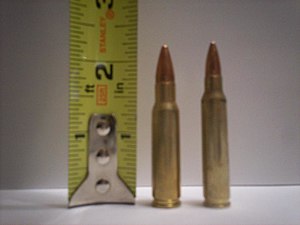
From Wikipedia, the 6.8 mm Remington SPC (or 6.8x43mm) is a new rifle cartridge that was developed with collaboration from individual members of US SOCOM. It is midway between the 5.56 and 7.62 in size and velocity with more energy than both. It is particularly adaptable to current 5.56 mm NATO, the cartridge length being relatively equal to the 5.56, the only modification required to the M4 is the upper receiver and barrel. The 6.8 delivers 44% greater energy than the 5.56 mm NATO at 100-200 meters, exactly the type of engagements detracting from the current bullet. The 6.8 does fall short of the 7.62, but maintains the higher carry capacity of the 5.56. (see offset picture, 6.8 on left, 5.56 on right)
The fact that we're having this discussion in public is great. Any discussion that puts better equipment in the hands of Soldiers is fine by me. Personally (if you couldn't already tell), I'm a big fan of the 6.8. Oh, I would also like to see it from a piston-driven AR variant like the FN SCAR, but that is a discussion for another day.
Thursday, May 22, 2008
Al-Queda in Iraq admitting defeat?
Probably not in so many words, but they are admitting their difficulties. Courtesy The Two Malcontents, on of Al-Queda's most prolific online supporters posted posted data on on of the premier 'jihadist' websites detailing the steep decline in insurgent operations by 94 percent over the last twelve months. Eighteen months ago, A-Qaeda accounted for 60 percent of Jihadist activity in Iraq. Now they find themselves owning less than 10.
According to the post, the author tallies up and compares the numbers of operations claimed by each insurgent group under four categories: a year and half ago (November 2006), a year ago (May 2007), six months ago (November 2007) and now (May 2008). He demonstrated that while Al-Qaeda’s Islamic State of Iraq could claim 334 operations in Nov. 06 and 292 in May 07, their violent output dropped to 25 in Nov. 07 and 16 so far in May 08. Keep in mind that these assessments are based on Al-Qaeda’s own numbers.


Disclaimer, I cannot read Arabic so I rely on the expertise of others. So what is the so-what? AQI is getting pasted and knows it. That one of their own felt necessary to post it (if he is one of theirs) is huge.
Subscribe to:
Posts (Atom)

